Help | Search Robot | Login

Riemann sum

Remaining Time: Unlimited

Riemann Sums

Let fx be defined on a closed interval a,b and let P be a regular partition of a,b. Let Δx be the width of each subinterval xi1,xiand for each i, let xit be any point in xi1,xi. A Riemann sum is defined for fx as


i=1nfxitΔx

Area under the curve using Riemann Sums

Let fx be a continuous, nonnegative function on an interval a,b, and let i=1nfxitΔx be a Riemann sum for fx. Then, the area under the curve y=fx on a,b is given by


A=limni=1nfxitΔx


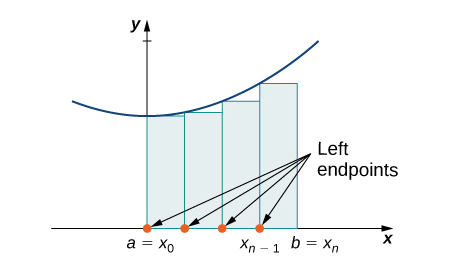
Left Endpoint Approximation

On each subinterval xi1,xi, construct a rectangle with width Δx and height equal to fxi1, which is the function value at the left endpoint of the subinterval. Then the area of this rectangle is fxi1Δx. Adding the areas of all these rectangles, we get an approximate value for A. We use the notation Ln to denote that this is a left-endpoint approximation of A using n subintervals.


ALn=fx0Δx+fx1Δx+...+fxn1Δx=i=1nfxi1Δx


Exercise:

Let Ln denote the corresponding left-endpoint sum. Compute \(L_6\) for the fx=41x on the indicated interval 2,5.


Round your answer to four decimal places.

\(L_6=\)  

HintPenalty 
Hint0.0


Exercise:

Select the correct left endpoint approximation for fx=6x on 1,2 ; use n=4


HintPenalty 
Hint0.0


Right Endpoint Approximation

Construct a rectangle on each subinterval xi1,xi, only this time the height of the rectangle is determined by the function value fxi at the right endpoint of the subinterval. Then, the area of each rectangle is fxiΔx and the approximation for A is given by:


ARn=fx1Δx+fx2Δx+...+fxnΔx=i=1nfxiΔx


Exercise:

Let Rn denote the corresponding right-endpoint sum. Compute R4 for the   g x = 5 cos πx   on the indicated interval 0,1.


Enter the exact answer.

R4=  

HintPenalty 
Hint0.0


Exercise:

Select the correct right end approximation formfx=4x on 1,2 ; use n=4

HintPenalty 
Hint0.0


Approximate the area

Riemann sum is a method used to approximate the area under a curve by dividing the region into smaller rectangles and summing their areas. Here's a brief explanation of how it works:


  1. Divide the interval of interest into smaller subintervals.
  2. Choose a representative point within each subinterval (left, right, or midpoint).
  3. Compute the function value at each representative point.
  4. Multiply each function value by the width of the corresponding subinterval.
  5. Sum up all the products obtained in the previous step.


By following these steps, the Riemann sum provides an approximation of the area under the curve. The accuracy of the approximation increases as the number of subintervals (and consequently, the rectangles) increases, approaching the exact area under the curve as the number of rectangles approaches infinity.


Exercise:

Approximate the area under the graph using the left endpoints and right endpoints for fx=3x on 1,2 ; use n=4


Round your answer to four decimal places.

Area using Left Endpoint = 


SectionAttempt 1 of 1
 
HintPenalty 
Hint0.0


Exercise:

A unit circle is made up of n wedges equivalent to the inner wedge in the figure. The base of the inner triangle is 1 unit and its height is  sin 2 π n   The base of the outer triangle is B=cosπn+sinπntanπn and the height is  H = B sin 2 π n  .

A wedge of a circle with angle 2Pi/n a being approximated by two triangles.

Enter the exact answer.


Find the area of the unit circle.

A=. 

Preview Change entry mode units2

HintPenalty 
Hint0.0
 
Build Number : 26f99a3