Volumes by slicing disks and method of washers
Definite integrals were introduced as a way to calculate areas of regions in the plane. It turns out that they can also be used to calculate volumes of solids!
In this module, we will revisit the theory of integration and discuss how this can be used to calculate certain volumes.
VOLUMES BY SLICING
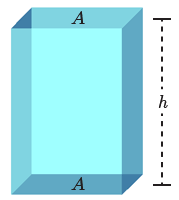
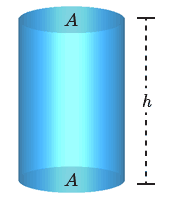
We'll start with a discussion of volumes of what we'll call simple solids. Consider the following three solids.
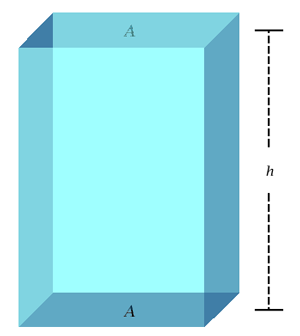
Rectangular box: \(A=l\times w\)
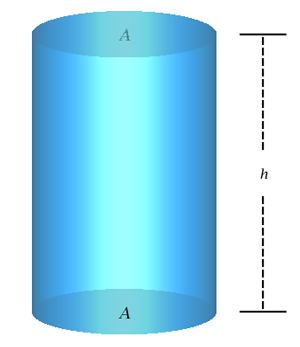
Right circular cylinder: \(A=\pi r^2\)
General base with area \(A\)
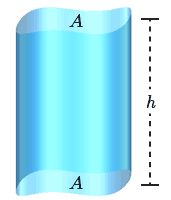
Two of the solids have familiar shapes. We have a rectangular box and we have a cylinder. The third isn't really any recognizable shape. We are interested in what these solids have in common.
In each solid we have the following in common:
- The top and bottom surfaces are congruent shapes that lie in parallel planes. In the case of the box, the surfaces are both the same rectangle. For the cylinder, they are both congruent circles. The surfaces for the third solid aren't recognizable shapes, but they are congruent. Of course, we have formulas to compute the areas of these top and bottom surfaces in the first two cases. For the rectangular box, we have a rectangle, which is length times width. And for the cylinder, in this case, the surface is a circle or a disk with a particular radius, so we get \(\pi r^2\). For the more general solid, we'll just label this area by \(A\).
- The sides of the solid meet the top and bottom surfaces at right angles. So have a look at the solids and make sure you agree with these observations. Because of this, we can talk about the idea of a fixed height of a solid, which we often denote by \(h\).
- if you intersect the solid with any plane parallel to the plane containing the base, then the region of intersection is, again, congruent to the top and bottom surfaces.
Cross Sections
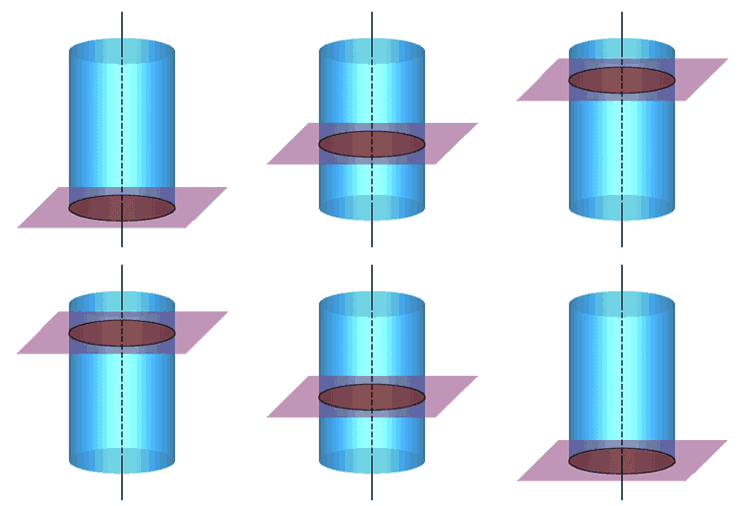
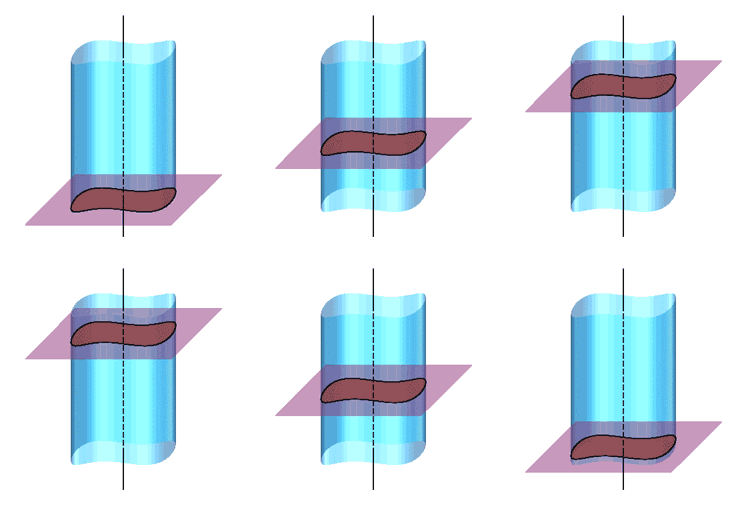
A two-dimensional region obtained by intersecting the solid with a plane is called a cross-section of the solid. Here we see an animation of the cross-sections of the three solids shown.
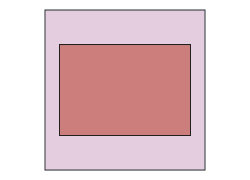
In the first solid, the box, all of the parallel planes produce the same rectangular cross-section.
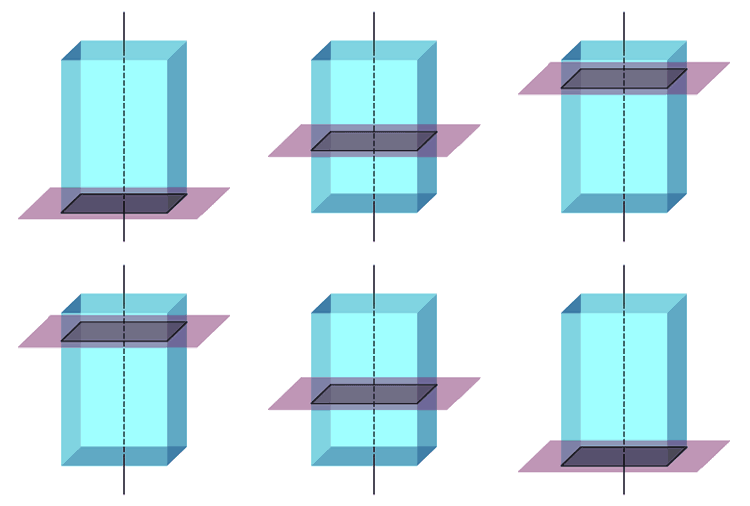
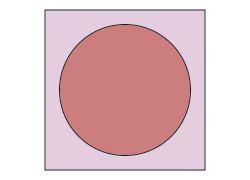
In the second solid, the cylinder, they produce the same circular cross-section.
In the last solid, the strange shape, the planes again produce this same, more general cross-section.
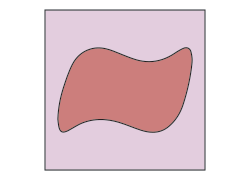
What this leads to is the fact that the volume of these solids can be calculated using the same formula:
\[ = \text{ cross-sectional area } \times \text{ height } = Ah\]
Now, we've already talked about how this height is well-defined. The height is the distance between the two surfaces, the top and the bottom. Also, we can say "the" cross-sectional area because we've discussed that no matter what plane you pick, it cuts out the exact same cross-section.
Now, this general formula for computing this volume matches, of course, what we already know about rectangular boxes and our circular cylinder. For example here are a few familiar special cases of this general formula:
- For the rectangular box, the top and bottom surfaces are rectangles. The cross-sectional area is length times width. Multiplying by the height, we get the familiar formula for the volume of a box, \(V = Ah = lwh\).
- For the cylinder, the top and bottom surfaces are circles, so a right circular cylinder has a volume of \(V= Ah = \pi r^2 h\).
We claim that this formula can actually compute more general solids, like the third one shown here.
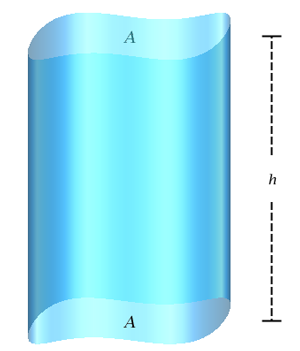
All that we require is that they have these nice properties we've described, having your top and bottom surfaces in parallel planes, the lines or the sides meeting these surfaces at right angles, and these nice cross-sections cutting out this constant cross-sectional area.
Now of course, the common use of the word cylinder is usually used to describe the second solid here. In fact, more formally, that would be called a right circular cylinder. So it really is a specific type of right cylinder. The word circular refers to the circular cross-sections. So if we have a more general right cylinder with a more general top and bottom surface, then we would call it a right cylinder without the circular. So what we've talked about here is that the volume of any right cylinder is given by \(V = A \times h\), where \(A\) is the cross-sectional area and \(h\) is the height. These will be taken to be our simple solids as we work through our module on volumes.
Any solid with the properties that we described is called a right cylinder. Keep in mind that the bases of a right cylinder do not have to be circular.
Let be a solid bounded by two parallel planes perpendicular to the -axis at , and . If for each in , the cross-sectional area of perpendicular to the -axis is , then the volume of the solid is
provided is integrable.
There is a similar result for cross-sections perpendicular to the -axis.
Let be a solid bounded by two parallel planes perpendicular to the -axis at and . If for each in , the cross-sectional area of perpendicular to the -axis is , then the volume of the solid is
provided is integrable.
In words, these formulas state:
The volume of a solid can be obtained by integrating the cross-sectional area from one end of the solid to the other.