Cross Product
An operation called the cross product, allows us to find a vector orthogonal to two given vectors.
Let and . Then, the cross product is vector
The direction of is given by the right-hand rule. If we hold the right hand out with the fingers pointing in the direction of then curl the fingers toward vector , the thumb points in the direction of the cross product, as shown.
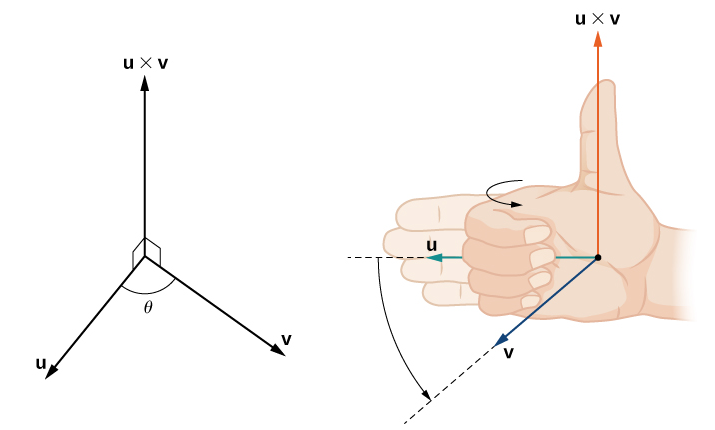
The direction of is determined by the right-hand rule.
Notice what this means for the direction of . If we apply the right-hand rule to , we start with our fingers pointed in the direction of , then curl our fingers toward the vector . In this case, the thumb points in the opposite direction of .
Note: The cross product of two vectors is a vector, so each of these products results in the zero vector, not the scalar 0.